
Minor Spoilers
Introduction: A Story Worth Sitting With
With the newest Plague Tale entry on the horizon, I figured it was finally time to go back and see what all the fuss was about with the original. A Plague Tale: Innocence is one of those games that seems to split people right down the middle, either it swept you up entirely, or you bounced off it somewhere in the middle and never looked back. Having finally sat down with Asobo Studio’s breakout hit myself, I can see exactly why both camps exist. This is a game built almost entirely on atmosphere and story, and when it’s working, it’s genuinely gorgeous, but the moment you start asking it to be a proper action or stealth game, the cracks show fast.
It’s not a game for anyone chasing a serious challenge or deep systems. If you want to relax in the evening with something moody, cinematic, and low-stakes to actually play, this delivers. If you’re coming in expecting Dishonored or Thief-level stealth depth, you’re going to be disappointed. And having finished it, I’ll be honest, I’m not rushing straight into the newer game just yet. More on why later.
Story and Characters: Amicia, Hugo, and the Weight of a Ruined France
The setup is strong. Amicia de Rune and her sickly younger brother Hugo are thrown into the chaos of plague-ravaged 1348 France after the Inquisition tears their family apart, and the early chapters do a genuinely excellent job of building dread and intimacy in equal measure. The sibling dynamic carries the entire experience, Amicia’s protectiveness and Hugo’s fragile innocence feel earned rather than manufactured, and I found myself invested in their survival almost immediately.
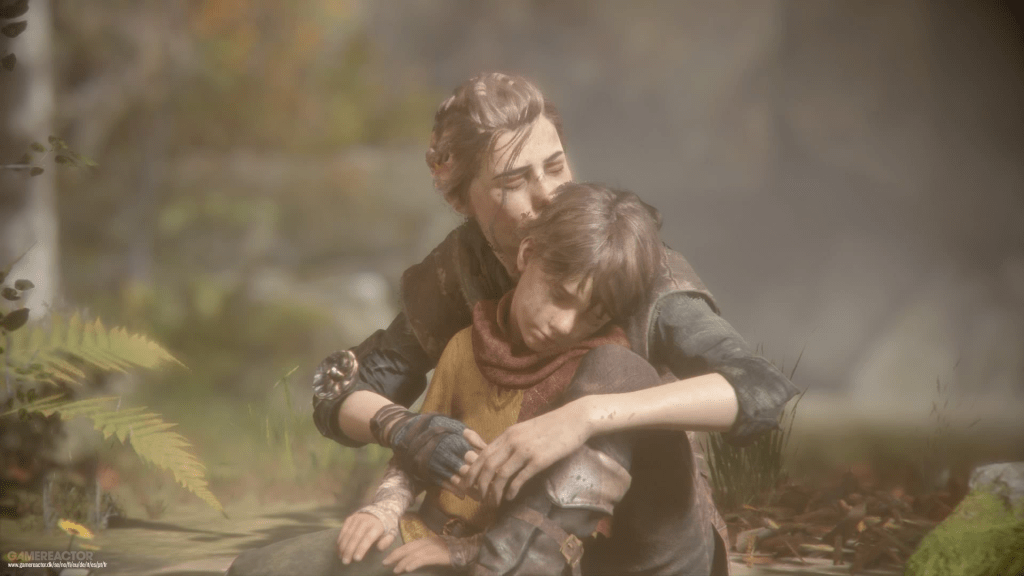
Figure 1: Amicia holds Hugo close in a rare quiet moment, the sibling bond that carries the entire game
Image Source: https://www.gamereactor.eu/watch-us-play-the-opening-of-a-plague-tale-innocence/
Where things get shakier is the back half. What starts as a grounded, harrowing survival story slowly tips into full supernatural territory, rat-controlling bloodlines, cartoonish, one-dimensional villains, and a final act that leans hard into spectacle over restraint. It’s not that the shift itself is unforgivable, plenty of great stories escalate, it’s that the villains in particular never earn the menace the game clearly wants them to have, and some of the supporting cast reads like it was written for a much younger audience than the opening chapters promised.
Gameplay and Stealth: A Puzzle Box, Not a Sandbox
This is where the game struggles most to justify its story-first approach. Stealth here is less about genuine improvisation and more about memorising a fixed sequence of events, most encounters have one intended solution, and enemy AI is forgiving enough that once you’ve upgraded your slingshot and pouches a little, entire sections stop being threatening at all. By chapter six or seven, it’s entirely possible to walk through most human encounters with barely a thought, which undercuts a lot of the tension the game spent its first few hours carefully building.
The crafting and upgrade systems are a nice touch on paper. You’re constantly on the lookout for materials as you explore, sulphur, saltpetre, resin, and pouches of various sizes, scattered as pickups across each level, and gathering them properly means actually detouring off the critical path rather than just following the story forward.
That material hunt feeds into expanding pouch capacity, sling range, and unlocking new alchemical tools, Ignifer to light things from a distance, Extinguis to douse flames and plunge guards into rat-friendly darkness, Chitin temporarily strengthens the sling, letting Amicia shatter helmets that would otherwise protect enemies.. so a headshot actually lands. On paper it reads like a real toolkit, and the exploration loop of scavenging for it is genuinely satisfying in the early chapters. In practice though, it leans more toward light RPG dressing than anything mechanically deep, most levels really only ask for one or two of these tools used in the correct order, rather than genuinely rewarding creative combinations.
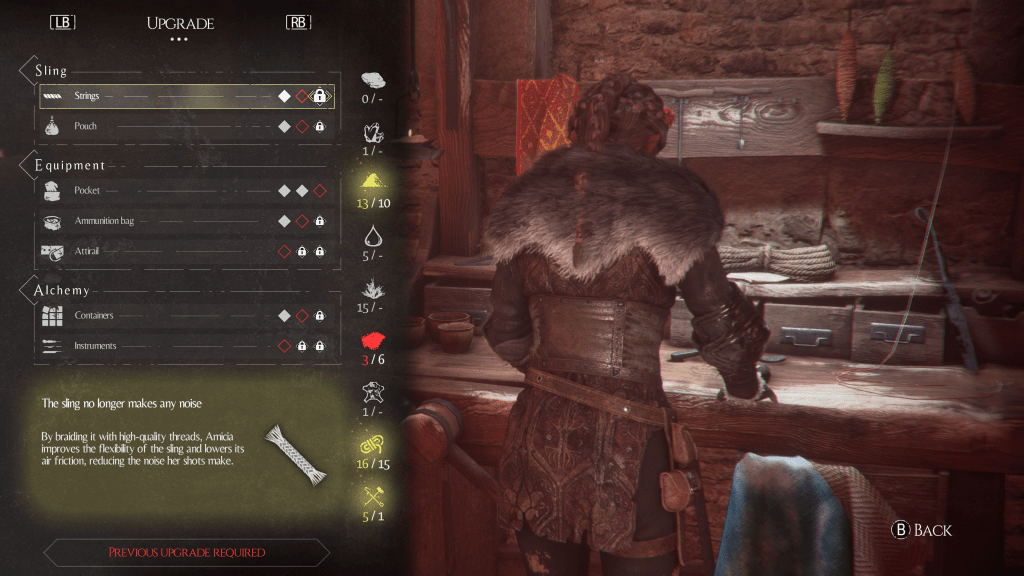
Figure 2: Amicia’s workbench, where sling, equipment, and alchemy upgrades are crafted using scavenged materials.
Image Source: https://www.reddit.com/r/APlagueTale/comments/1rcbps1/why_does_it_take_so_long_to_upgrade_her_gear_in/
When it works, clearing a guard patrol using fire, distraction, and a well-placed headshot feels satisfying. When it doesn’t, and it doesn’t fairly often in the later chapters, it feels like rigid trial-and-error dressed up as a puzzle, die, learn the scripted enemy pattern, try again with the correct sequence memorised. The tools are rarely the problem, it’s that the game so often only wants you to use them one specific way.
Visuals and Atmosphere: A Technical Marvel
Whatever you think of the gameplay, the presentation is where A Plague Tale earns its reputation. The sheer density of rats Asobo manage to render on screen at once, forming writhing, light-fearing swarms that flood entire streets, is a genuinely impressive technical achievement, especially for a studio this size. Beyond the rats, the environments themselves carry real weight, rotting villages, burning farmland, frozen abandoned châteaus, a genuinely eerie cathedral, each new setting feels considered and purposeful rather than reused.
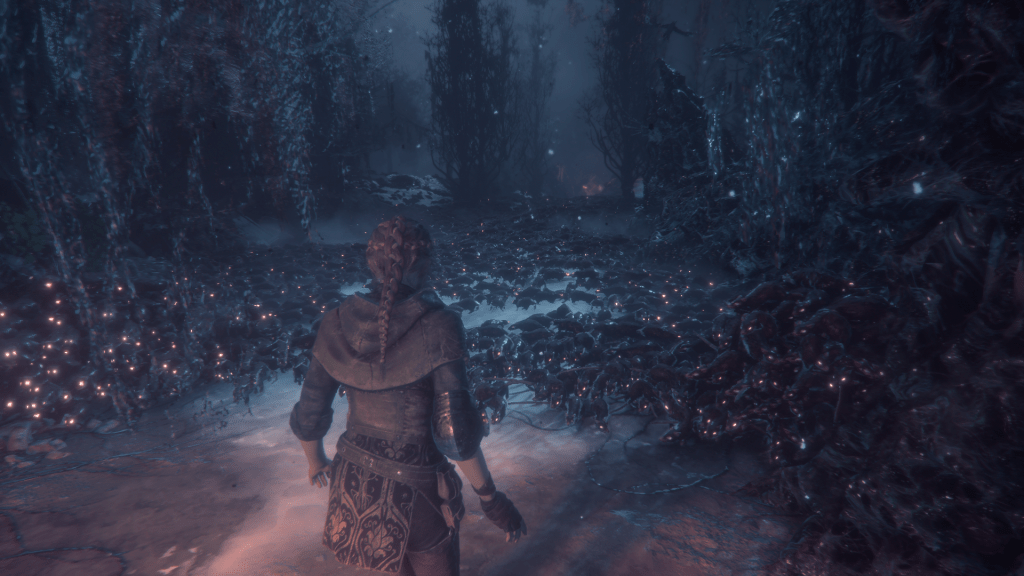
Figure 3: A rat swarm stretches into the darkness, hundreds of them rendered on screen at once, and still one of the most striking technical feats in the game.
Image Source: https://www.rockpapershotgun.com/a-plague-tale-innocence-review
Sound: The Real Main Character
If there’s one element of A Plague Tale that deserves praise, it’s the score. Olivier Deriviere’s soundtrack does a large amount of the emotional heavy lifting throughout, and during the game’s best moments, the music elevates scenes that the writing alone might not have fully earned. Voice acting is generally strong too, Amicia and Hugo’s performances carry real warmth and vulnerability. Although I did find that Amicia speaks with a distinct French accent while both her parents sound distinctly British, which is a strange, occasionally distracting choice for a story so rooted in a specific time and place.
Accessibility: A Smaller Studio’s Growing Pains
As is often the case with a smaller-scale studio’s first big narrative swing, accessibility here is a mixed bag rather than a genuine strength. On the plus side, the slingshot aim assist is a nice addition, get roughly close to a target and the game snaps your aim to it with a clear indicator line, which makes ranged encounters far more forgiving for anyone who struggles with precise aiming. Though I don’t think it always worked as well as it should have, especially when enemies are actively rushing towards you, it felt like it could fumble under pressure exactly when you needed it most. There’s also a toggle to highlight interactive items and useful pickups in the environment, handy for players with visual impairments navigating busy, dimly lit scenes.
Where it falls down is everywhere else. Notably, there’s no difficulty setting whatsoever, the game is a fixed, binary experience for every player regardless of ability. On top of that, the game leans on the entire controller, triggers for aiming and sprinting, face buttons for crafting and interacting, with no option to remap controls on console at all beyond two preset layouts, which is a real barrier for anyone with limited mobility or a non-standard input preference.
Subtitles are also a big issue, they suffer from poor contrast against many of the game’s brighter or more chaotic backgrounds, meaning deaf and hard-of-hearing players relying on them risk missing chunks of story dialogue during the scenes where the plot matters most. For a game this narrative-heavy, that’s a fairly significant gap.
It’s not a game built with accessibility as a priority from the ground up, and it shows, the aim assist and interactive highlights help a little, but there’s no meaningful way to soften the actual challenge for anyone who needs it.
The Final Verdict: Beauty Amid the Plague
A Plague Tale: Innocence is a genuinely difficult game to score cleanly, because its two halves, the story-and-atmosphere half and the actual moment-to-moment gameplay half, sit at noticeably different quality levels. The first few hours are close to essential, atmospheric, intimate, and confident. The back half asks a lot more patience, leaning on scripted trial-and-error, a shakier plot, and an accessibility suite that hasn’t kept pace with the presentation around it.
So, has it aged like the plague, or is it still worth your time? Honestly, it depends entirely on what you’re after. If you want a moody, linear, story-first experience and can forgive thin combat and a wobbly final act, this is still very much worth your evening hours. If you need your gameplay to match the ambition of your narrative, you may find yourselfquietly abandoning it
As for Requiem, I’ve heard it addresses many of the issues I had with Innocence, offering more encounter freedom, a tighter story and broader gameplay systems. Whether it fully delivers on that promise is something I’ll find out soon enough
Rating: 3/5
Time Played: 11 hours
Achievements: 35/35 (1000g/1000g)



Leave a Reply