
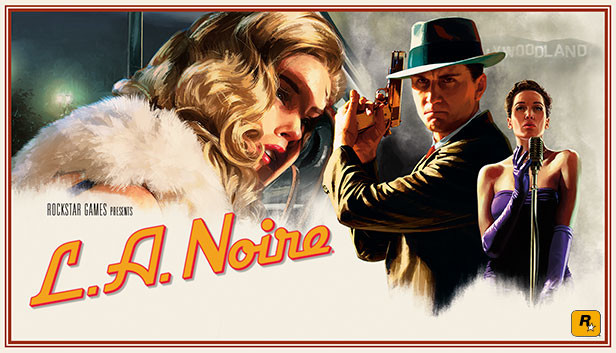
Originally released in 2011 by Rockstar Games (and developed by Team Bondi), L.A. Noire arrived during a period where Rockstar could seemingly do no wrong, following the success of Grand Theft Auto IV and Red Dead Redemption. But instead of doubling down on their open-world chaos formula, they took a risk.
The 2017 remaster (played here on Xbox Series X) brings the experience to modern hardware, but at its core, this is still a very different kind of Rockstar game. One that trades instant gratification for patience and attention to detail.
It’s also worth being clear: this is a much more adult-focused experience. Not in the obvious sense, but in how it demands you engage with it. While younger audiences can jump into something like GTA and have fun immediately, L.A. Noire asks you to slow down, observe, and think. That makes it fascinating, but also far less accessible in terms of pure pick-up-and-play enjoyment.
For me, this was my first time playing, having been too young when it originally released and with the game sitting in my backlog for years, finally experiencing it in full adds an extra layer of appreciation for its ambition and style.
Setting: A Noir City of Shadows and Secrets, 1947 L.A.
What immediately stands out is just how convincing its version of 1947 Los Angeles feels. There’s a deliberate pace to everything, from the way characters speak to how the city breathes around you, that sells the illusion of stepping into a classic noir film.
This isn’t just aesthetic either. The game draws heavily from real-world influences, weaving in post-war tension, corruption, and high-profile crimes of the era. Even when the gameplay falters, the atmosphere rarely does. There’s a clear reverence for cinema here, and for fans of that era, it’s incredibly easy to get immersed.
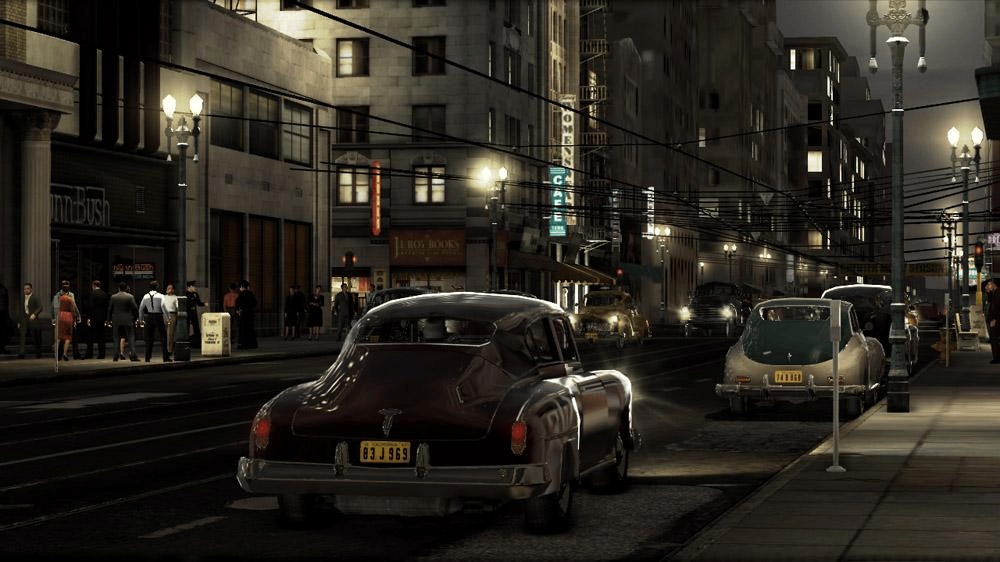
Figure 1: Scenery showcasing 1940s Los Angeles, highlighting the game’s atmospheric world design, period-accurate vehicles, and noir-inspired lighting.
Image Source: https://www.playthepast.org/?p=4243
Gameplay: Sharp at First, Dull by Midnight
At first, the gameplay loop feels genuinely refreshing. You’re not mowing down enemies or causing chaos, you’re investigating. Searching crime scenes, analysing evidence, and questioning suspects feels methodical and grounded in a way few games attempt.
There are some really smart touches too. The clue system, for example, is guided subtly through music, once you’ve found everything of importance, the investigative soundtrack fades away. It’s a small detail, but one that works beautifully.
However, as the cases stack up, the cracks begin to show. What initially feels unique gradually becomes repetitive, and the structure rarely evolves in meaningful ways. By the midpoint, you’ve effectively seen everything the game has to offer mechanically.
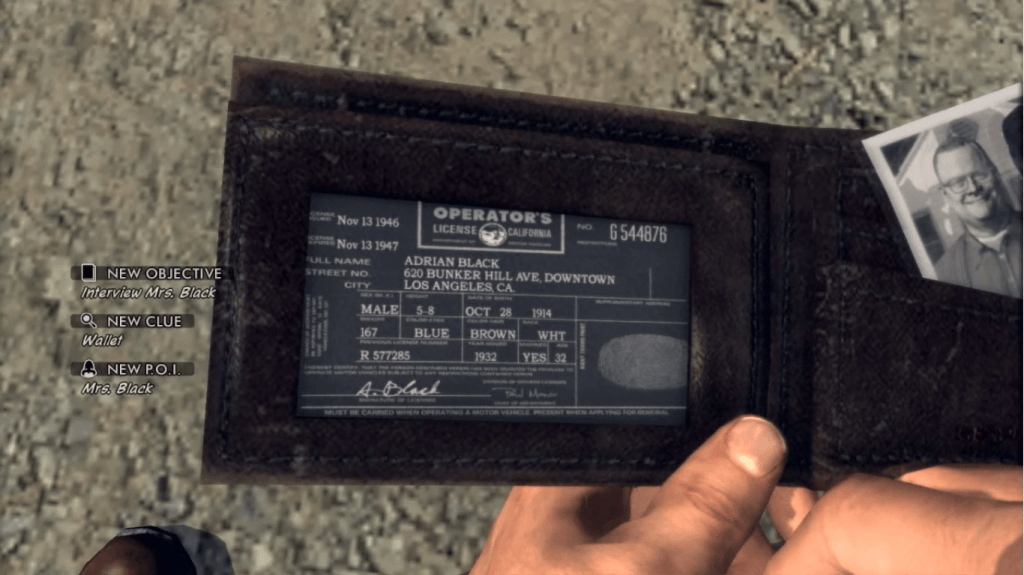
Figure 2: Player examining a wallet and identification card, highlighting the game’s evidence-based investigation mechanics.
Image Source: https://lanoire.fandom.com/wiki/Evidence
Interrogations: Reading Faces, Fighting Logic
The headline feature – facial animation used to detect lies, is both the game’s greatest strength and its biggest weakness. MotionScan technology is a groundbreaking achievement, letting players read subtle micro-expressions to detect deception or truth. When it works, it’s brilliant, linking subtle tells to evidence in a way that feels incredibly satisfying.
However, expressions are often over-exaggerated on purpose so the tech can reliably pick up the tells, which can make characters seem deceptive even when they’re not. This can create moments where your instincts feel punished rather than rewarded, adding a layer of unpredictability to interrogations.

Figure 3: Example of an over-exaggerated facial expression to show that the suspect is lying
Image Source: https://www.itechpost.com/articles/118860/20230903/revisiting-la-noire-press-x-doubt.htm
There’s also a disconnect between player intent and character response. Choosing an option like “Doubt” (or “Bad Cop” in the remaster) can trigger unexpectedly aggressive dialogue, making interrogations feel less like careful deduction and more like trial and error. At times, it genuinely feels like you’re battling the game’s logic rather than solving a case, but despite these flaws, it remains a remarkable feat in narrative-driven detective gameplay.
Little Replay Value: Once You Know, the Mystery Fades
One of the biggest issues is how little replay value the game offers. Once you’ve completed a case, you already know the answers – the clues, the lies, the outcomes. There’s no real room for reinterpretation or alternative approaches.
That lack of flexibility becomes more noticeable as the game goes on. The first handful of cases feel fresh and engaging, but after ten or so, the repetition sets in. What was once gripping starts to feel predictable, and the sense of discovery fades.
An Open World That Feels Underused: More Scenery Than Sandbox
Los Angeles is technically open-world, but it doesn’t function like a traditional Rockstar sandbox. You can drive around, respond to street crimes, and hunt for collectibles, yet the city often feels more like a backdrop than a fully interactive system.
Street crimes, while simple and repetitive, are oddly relaxing, quick bursts of action that break up the slower investigative pace. Beyond that, there’s a lingering sense that more could have been done with the space; it feels like a foundation for something bigger that never fully materialised.
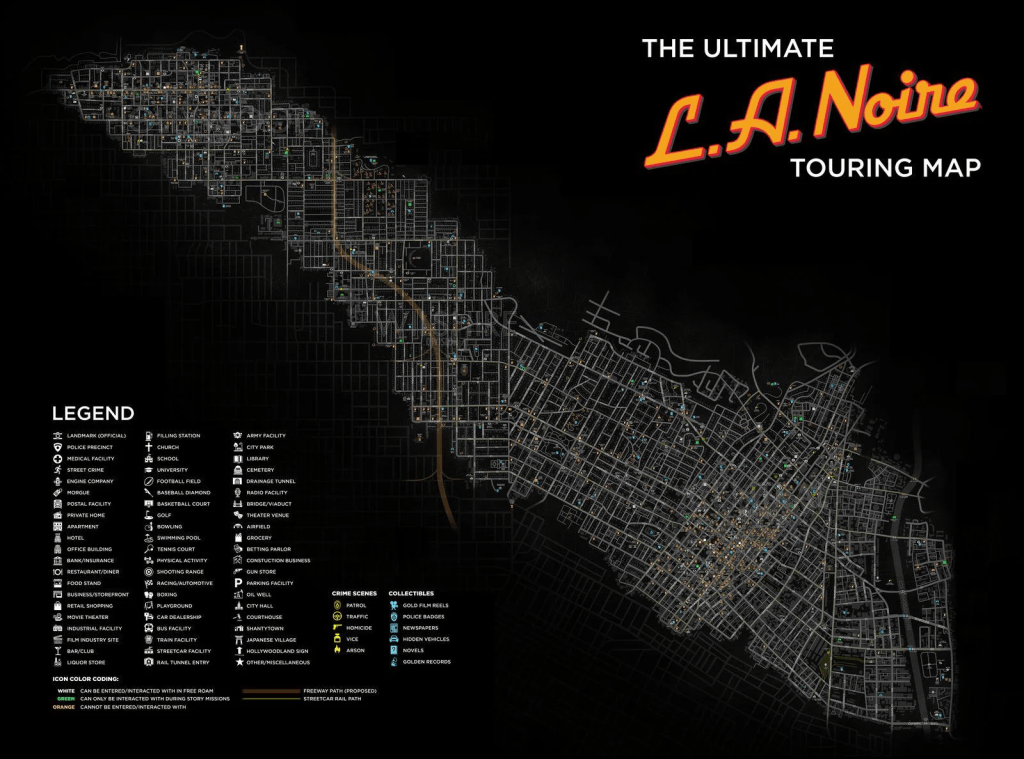
Figure 4: The full map, highlighting the city’s impressive scale, though much of it feels largely empty and underutilised.
Image Source: https://www.reddit.com/r/lanoire/comments/1d1s30o/utohubohufilm_made_an_ultimate_la_noire_map/
You’re also always in a case unless you specifically drop out to free roam, which means any damage you cause (destroyed cars, property, or to people), accumulates in case damage costs, adding an extra layer of tension even during seemingly minor exploration.
Combat & Driving: Chasing Crime Through a Flawed Lens
Combat is easily the weakest part of the experience. Taking cover feels slow and awkward, gunplay lacks precision, and the absence of a clear health system can make encounters feel unpredictable and frustrating. Aim assist doesn’t always behave as expected either, sometimes locking onto less relevant targets in chaotic situations.
Driving isn’t much better. AI vehicles have a tendency to behave erratically, often swerving into you for no clear reason, something that becomes especially frustrating when the game penalises you for damage costs. It can feel like you’re being punished for things outside your control, which undermines the scoring system entirely.
Soundtrack & Audio Design: From Moody Jazz to Distracting Hum
One area Rockstar rarely misses in is music, and that holds true here. The score, composed by Andrew Hale, does an excellent job of reinforcing the noir tone – moody, understated, and perfectly in line with the setting.
However, there are some odd limitations and inconsistencies. You can’t manually toggle the radio on or off, and there’s no control over stations (as far as I was aware), which feels restrictive compared to other Rockstar titles. It’s a strange omission given how strong their history with in-game radio is.
Audio design can also be hit or miss. At times, background noise feels excessive or poorly balanced – random tyre screeches, ambient sounds, and inconsistent reverb between characters can break immersion in quieter moments, particularly during interrogations. There’s also a persistent, hard-to-identify hum that constantly plays in the background, likely part of the game’s ambient sound mix, which can become extremely distracting over time.
Accessibility & UX Options: A Solid Base That Falls Short of Modern Standards
L.A. Noire (Remastered) offers a respectable range of accessibility and UX settings on paper, but in practice, it feels like a system that was forward-thinking for its time yet noticeably behind modern expectations.
- Clue Music Toggle (Auto / On) – Music fades when all clues are found
- Clue Hints (Off / On / Visual) – Audio cues, vibration, and optional icon
- Action Skip (Off / On) – Skip sequences after repeated failure
- Invert Y-Axis only (no X-axis option)
- Aim Sensitivity Slider
- Aim Assist (Off / Low / High)
- Photo Mode Toggle (LS + RS) – Disabled in HDR
- Audio Sliders – Music, effects, dialogue
- Subtitles (On / Off)
- Black & White Mode (On / Off)
- Brightness Slider
- Camera Automation (On / Off)
- Camera Shake (On / Off)
- ❌ No controller remapping
- ❌ No cutscene skipping
There are some genuinely strong ideas here. The clue assistance options are particularly well handled, allowing you to tailor how much help you receive, from subtle audio cues to full visual indicators. This makes the investigative side of the game far more approachable, especially for players who might struggle with attention to detail or sensory overload. Similarly, the inclusion of action skip is a quietly excellent feature, letting players bypass frustrating combat or chase sequences after repeated failures, something that more games should adopt.
However, the cracks show pretty quickly. The lack of controller remapping is a major omission, especially for a game that mixes driving, shooting, and slow-paced investigation. Limiting players to only a Y-axis inversion without offering X-axis control also feels unnecessarily restrictive. These are basic features by today’s standards, and their absence will be immediately noticeable to many players.
The inability to skip cutscenes is another frustrating limitation. In a game where failure can lead to repetition, being forced to rewatch scenes breaks the flow and becomes more of a barrier than a cinematic benefit.
There are also smaller usability quirks, like certain toggles being context-dependent (such as photo mode not working in HDR), that make the overall experience feel slightly inconsistent.
Ultimately, L.A. Noire provides a decent level of accessibility for its era, with a few standout features that still hold up well. But when viewed through a modern lens, it feels more like a foundation than a fully realised system. It’s functional, and occasionally thoughtful, but far from comprehensive.
Wrapping Up the Case: Is L.A. Noire Worth Revisiting?
L.A. Noire is a fascinating, ambitious game that still feels unlike anything else Rockstar has made. Its atmosphere, setting, and core concept are genuinely compelling, and for a while, it delivers something truly special, a detective experience steeped in noir tension, intricate cases, and a meticulously recreated 1947 Los Angeles.
But it’s also a game that shows its age. The repetition, clunky mechanics, and occasional design frustrations hold it back from greatness. In many ways, it feels like a proof of concept for a world and gameplay style that was never fully realised.
Still, there’s enough here to appreciate, especially if you’re drawn to its story, characters, and immersive tone. For fans of noir or anyone curious about a unique approach to detective games, it remains a title worth exploring, even decades later.
Rating: 3.5 / 5
Playtime: 48 Hours
Achievements: 62/62 (1500G)




Leave a Reply