

Dredge, developed by the indie studio Black Salt Games, is a masterclass in blending seemingly disparate genres: a casual fishing simulator and cosmic horror. This unlikely combination creates an atmospheric experience that’s as haunting as it is cozy.
Released in 2023, Dredge has garnered widespread praise for its unique premise, polished gameplay, and immersive world, and it’s no surprise why. As an indie title, it’s remarkably flawless, with only one minor bug in my playthrough (a menu glitch that a quick restart fixed, thanks to the game’s frequent autosaving). Below, I’ll dive into the world, gameplay, biomes, tools, accessibility, and standout sound design, all while keeping this review mostly spoiler-free.
The Premise: A Fisherman in an Unsettling World
In Dredge, you play as a fisherman arriving at a chain of islands, greeted by locals who seem… off. The towns feel rundown, the people peculiar, and warnings are given to you about staying out too late. The game’s genius lies in its ability to balance a cozy fishing loop with an undercurrent of Lovecraftian dread. You’ll sail, fish, and upgrade your boat while uncovering mysteries, but the deeper you go, the more you realise something unnatural lurks beneath the waves.
Gameplay: Fishing, Exploring, and Upgrading
At its core, Dredge is about fishing, exploring, and upgrading your boat. You’ll sail across regions, catch fish, complete quests, and manage your inventory in a Resident Evil 4-style grid, where fish and gear come in different shapes and sizes. Rearranging your hold to maximise space is oddly satisfying, though it can be a balancing act when equipping gear for specific areas. The game’s progression feels rewarding, with each upgrade, faster engines, better rods, or brighter lights, making you feel more capable against the ocean’s dangers.

Figure 1: Dredge’s inventory management system
Image Source: https://www.gamedeveloper.com/design/deep-dive-the-surprising-depth-of-spatial-inventories-in-dredge
Time management is a key mechanic. Time only passes when you’re moving, fishing, dredging, or sleeping, allowing you to pause and plan without pressure. Early on, time feels tight; a trip to a fishing spot can turn to night before you’re ready, forcing you to brave the dark or head back preemptively. Upgraded engines alleviate this, making travel faster and less stressful, however, I found the initial slow pace heightened the tension.
The main quest has you chasing relics for a shadowy figure, pulling you deeper into the game’s eerie narrative, while side quests keep things lively with rewards like cash, gear, or research parts. Along the way, you’ll pick up books you can read while sailing, each granting passive boosts, like faster engines or calmer nerves, that stack up nicely and make you feel like a seasoned captain.
Even after the main story wraps, there’s a healthy chunk of endgame content; such as completing side quests, catching every species and aberration, and fully upgrading your boat; offering plenty of reasons to stay out on the water a little longer.
Fishing is great fun, with each species tied to a unique mini-game that’s engaging without being harsh. If you make the catch on a yellow bar, you get a trophy fish worth more money. Miss the mark, and your progress resets some of your fishing progress. The 4 types of fishing mini-games are as follows:
● Radial has you time your rod pull when a circling indicator hits green or yellow bars.
● Ball Catcher involves pulling when rising green or yellow balls reach a red bar.
● Diamond requires aligning a green or yellow circle with a red one.
● Pendulum has you time your pull as an indicator swings through green or yellow bars.

Figure 2: The “Radial” fishing mini-game
Image Source: https://dredge.wiki.gg/wiki/Minigames
Dredging, the other major mechanic, involves playing a timed mini-game where you guide a marker through a circular track, avoiding the gaps to unearth materials or treasures vital for upgrades and progressing the story.
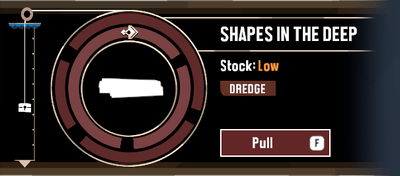
Figure 3: The “Dredging” mini-game
Image Source: https://dredge.wiki.gg/wiki/Minigames
The Biomes: A Haunting Archipelago
Dredge’s world unfolds across five distinct biomes, each with its own atmosphere and challenges that make sailing both thrilling and eerie. The Marrows is your starting point, it feels like a safe haven with calm waters and small towns, perfect for learning how to fish, dredge, and quest; but watch out for rocks that seem to appear from nowhere at night.
Gale Cliffs marks a shift in Dredge’s tone and pacing. Its geography is tight and claustrophobic with it’s narrow passages that demand precise navigation. But it’s not just the terrain that makes things tense, something patrols the area, quickly and aggressively, adding real urgency to every trip. You’ll hear it before you see it: low rumbles, subtle distortions, a creeping sense of dread. It punishes mistakes, but with smart routing and a strong engine, you can stay ahead. The risk is real, but so are the rewards.
Stellar Basin draws you in with deceptively serene, tropical waters and the remnants of a once-bustling research outpost. Vibrant coral and rare fish make it a tempting spot to explore, but the deeper you venture, the more oppressive it becomes. Something stirs in the vast, open center of the basin, watching and waiting.
Twisted Strand takes you deep into a murky, overgrown swamp where the air feels thick and the light barely filters through. Navigation is tight and the threats are subtle but unnerving. Even after overcoming its central danger, the area can feel a bit sparse, yet the atmosphere lingers, with low, droning strings in the soundtrack keeping the tension simmering. It’s a place that leans heavily on mood over activity.
Devil’s Spine brings the journey to a climax in a volcanic, labyrinth region filled with ancient ruins and boiling seas. Visibility is poor, and the unsettling cries of bizarre fish echo across the rocks. The music here is especially haunting, tense, and ambient.
Each biome offers its own distinct challenges and haunting beauty, making the archipelago a consistently fascinating place to explore.

Figure 4: The in game map showing the 5 named locations
Image Source: https://www.playstationtrophies.org/game/dredge/guide/
Monsters & Terrors
⚠️ Mild Spoilers — This section touches on creature encounters and gameplay dynamics tied to them.
The ocean in Dredge isn’t empty. Each region introduces its own lurking threat, hazards that influence how and when you travel. Some creatures are massive and fast, forcing you to plan your route or rely on speed boosts to stay ahead. Others can be seen from afar, giving you time to avoid them, while a few lie in wait and ambush with little warning, turning quiet moments into panic-fueled scrambles.
What makes these threats effective isn’t just their design, but how they reinforce the game’s tension. You’re rarely safe, especially at night, and their presence adds urgency to otherwise simple tasks. They’re well-integrated into each biome’s layout and tone, pushing you to master navigation, use tools wisely, and keep your cool when things go wrong.
Tools: Non-Magical and Magical
Your boat’s tools are divided into non-magical and magical categories, each enhancing gameplay in unique ways. Here’s a rundown:
Non-Magical Tools
● Light: Toggles your boat’s lights, improving visibility and reducing panic in the dark. Essential for nighttime navigation.
● Foghorn: A loud HONK that scares off crows and alerts monsters. It’s both practical and fun to use.
● Spyglass: Scouts fishing or dredging spots from afar, revealing their contents. (I overlooked this tool initially, manually checking every spot but sailing over to it, and it was a game changer for sure.)
● Trawl Net: Passively collects fish in a dedicated cargo tab, staying fresh until retrieved. Its durability degrades over time but can be repaired.
● Crab Pot: Placed to passively catch crabs and other sea life. Like trawl nets, they degrade but can be repaired
● Bait: Creates a temporary fishing spot with regional fish, unaffected by the day-night cycle. It’s great for catching rare species like sunfish without waiting for the right time.
Magical Tools
⚠️ Mild Story-Related Spoilers — These abilities unlock through the main quest and hint at supernatural elements.
● Haste: Temporarily boosts your speed, ideal for quick escapes or covering distance fast. Overuse causes engine failure and increases panic, with a disturbing engine sound that ramps up the tension.
● Manifest: Instantly teleports your boat to a key safe location. A powerful get-out-of-trouble tool with a long cooldown.
● Banish: Temporarily repels hostile threats nearby.
● Atrophy: Instantly harvests fish from a fishing spot, often yielding aberrant variants.
Each of these abilities comes with a cooldown and fits seamlessly into the game’s eerie tone, adding a layer of supernatural strategy without overpowering the core mechanics.

Figure 5: The in-game tools wheel
Image Source: https://dredge.fandom.com/wiki/Abilities
Sound Design and OST: Quietly Effective
The soundtrack, composed by David Mason, does a solid job of reinforcing the game’s mood without overstaying its welcome. Tracks help to distinguish the regions that you are in, and subtle shifts in instrumentation reflect the tone of each biome; from the relaxed feel of The Marrows to the unease of Devil’s Spine. There’s a tasteful restraint in the composition, it never tries too hard to grab your attention.
The sound effects are simple, but thoughtfully executed. The slap of fish in your hold, the clink of dredged scrap, and the hum of your boat’s engine all add texture without becoming repetitive. My standout sound effect is the warped chord that plays when you catch an aberration, it’s jarring in the best way. And during the night time, when music often drops out entirely, the ambient audio does most of the heavy lifting, selling the isolation and unease. It’s not the most complex soundscape out there, but it works well for what Dredge is trying to achieve.
Accessibility: Impressively Inclusive
Dredge includes an fantasticly robust accessibility menu, offering a wide range of options that let players tailor the experience to their needs and preferences. You can disable hostile elements entirely, turning the game into a peaceful fishing sim, making it infinitely less scares.
Beyond that, there’s a deep set of tweaks: VFX toggles, turning deadzone sliders, and full control remapping. Text speed, popup notification timing, clock style (12/24hr), and unit preferences (metric/imperial) are also adjustable.
Visual accessibility is particularly well-considered, with colourblind support that includes multiple palette options for different UI elements (positive, negative, emphasis, and important). You can also toggle reflections and fine-tune camera sensitivity or inversion.
On the audio side, separate sliders for master volume, music, SFX, UI, and character voices help balance the sound mix to your liking. Whether you’re here for the horror or just the fishing, Dredge makes it easy to play your way, without compromising its mood.

Figure 6: Accessibility menu showcasing colour blindness settings
Image Source: https://caniplaythat.com/2023/05/10/dredge-accessibility-review/
Final Thoughts
Dredge delivers a unique blend of eerie atmosphere and relaxing gameplay that kept me hooked until 100% completion for over 15 hours. It strikes a rare balance between cozy and creepy, and while the horror element fades a bit once you’re fully upgraded, the world remains a joy to explore. There’s a clear artistic vision here, supported by thoughtful mechanics, a strong progression loop, and just enough weirdness to keep things intriguing.
It’s not perfect, a slightly empty world and some pacing issues early on held it back from full marks, but as an indie title, it’s impressively polished and memorable. I may not dive into the DLCs, but what’s here already feels like a complete and satisfying experience. Highly recommended for fans of low-stakes horror, exploration, and good vibes with an edge.
Playtime: 15 hours 30 minutes
Achievements: 40/60 (all base game achievements unlocked)
Rating: 4/5 Abberations




 Kirbylife Game Research & Reviews
Leave a comment