Note: Written before the release of season 1
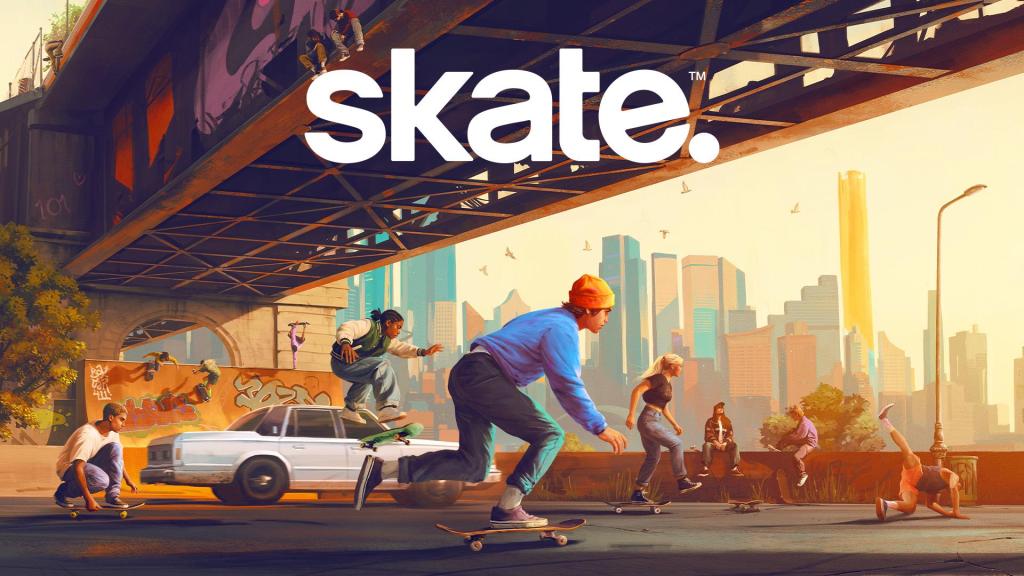
After more than a decade since Skate 3, EA has returned to the streets with Skate., a free-to-play, live-service reimagining of the series.
For veterans of Skate 1–3, hopping back on the board is a thrill. The flick-it controls feel instantly familiar, and the core skating delivers that satisfying weight and flow fans remember.
That said, Skate. is clearly still in its early days. While the skating itself is a joy, the world, customisation, and available modes show rough edges. Across many hours of play, I’ve found moments of brilliance alongside areas that feel unfinished. This isn’t the polished sequel some fans might have hoped for, but it’s an exciting start that shows real potential for the future.
The Feel of Skating
The most crucial test for any Skate game is simple: does skating feel good? Thankfully, it does. The flick-it controls still feel instinctive and satisfying, snapping back into place almost immediately, even after years away from the franchise. The flow of pushing, popping, and flicking has retained that familiar sense of weight and precision, and it’s still one of the most tactile control schemes in sports gaming.

Figure 1: Flick-it controls guide, illustrating precision needed to land tricks.
Image Source: https://gamedev.stackexchange.com/questions/182534/comparing-analog-stick-movements-to-predefined-flick-shapes
Animations carry a real sense of style and momentum. Tricks look crisp and expressive, whether you’re grinding a handrail, locking a manual, or flipping a board down a set. New additions like slappies and wallies are a highlight, adding depth and authenticity to street skating. Lip tricks and stalls, while clumsy at times, can be rewarding when executed cleanly. In short, Skate. captures the essence of skating: playful, creative, and just as capable of realism as it is of chaos.
That said, the absence of series staples like fingerflips and darkcatches is hard to ignore. Promises of future updates soften the blow, but for now, the move set feels incomplete.
The audio design supports this beautifully. Wheels hum, trucks snap against coping, and bails sound convincingly painful. The soundtrack is promising too, with Turnstile already making an impact, though it doesn’t yet match the iconic playlists of earlier entries. With seasonal updates, it could get there.
Character Models and Customisation
Where the skating succeeds, character customisation falters. Models look overly cartoonish, with flat features and awkward hair options that undermine attempts at realism. It feels more like a stylised comic than a modern sports sim.

Figure 2: Character customisation menu in Skate.
Image Source: https://www.reddit.com/r/Skate4/comments/1lsum5l/the_really_do_look_different/
Gear customisation is similarly disappointing. Much of it is tied to loot boxes, where basic items dominate and branded equipment is locked behind rarer “collector” drops. While technically earnable in-game, the system forces players through a grind that feels restrictive. The absence of accessible branded gear, something that made Skate 3 so immersive, stands out as a regression.
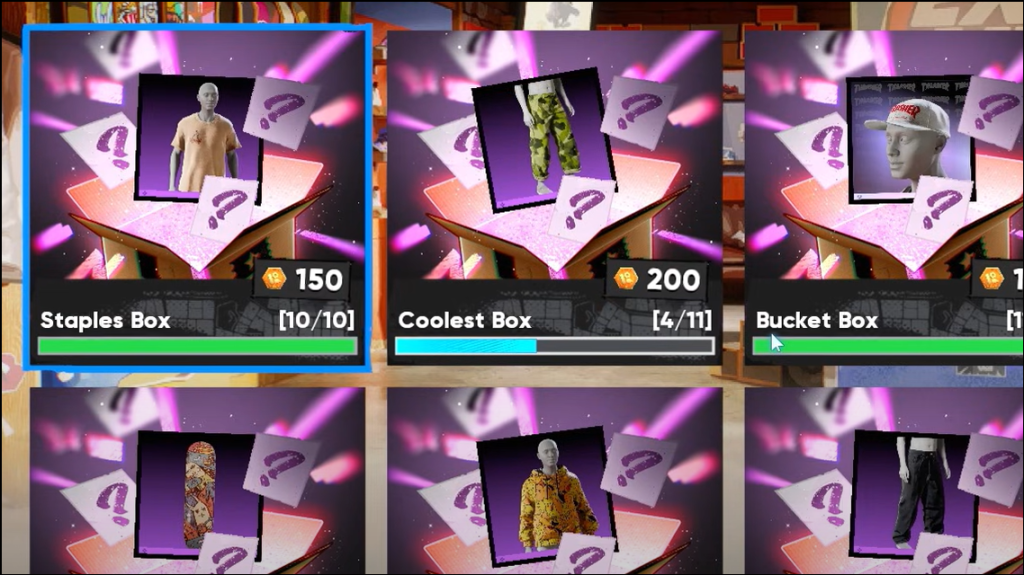
Figure 3: In-game store, depicting lootboxes filled with cosmetics
Image Source: https://allthings.how/skate-early-access-make-money-and-unlock-free-cosmetics/
Microtransactions compound the problem. Branded gear often sits behind real-money purchases, undermining the creative freedom that defined the earlier games. While monetisation is purely cosmetic and not pay-to-win, it still leaves customisation feeling less expressive than it should be. The addition of emotes like flossing or Naruto running may amuse some, but for returning players, it highlights a generational gap in tone.
The Map
San VanPark, the new city, struggles to leave an impression. It’s small, crossable in just a few minutes, and though it has pockets of skateable spots, it lacks the distinctive plazas, hills, and memorable parks of its predecessors. Worse, many areas feel deliberately obstructed, with bins, vending machines, and other clutter blocking obvious lines. Unlike in Skate 3, you can’t clear obstacles, only add new ones via the object dropper, which is capped at five active items.
The city is divided into four main districts that gradually unlock as you progress: Hedgemont, Gullcrest Village, Market Mile, and the upcoming Brickswich. While Brickswich is technically skateable, it currently offers little beyond empty space and no missions, clearly reserved for future updates.
One nice touch is being able to see other players skating around the city as you explore. Whether they’re freeskating, attempting challenges, or just messing around, it helps San VanPark feel like a shared playground rather than a single-player backdrop.
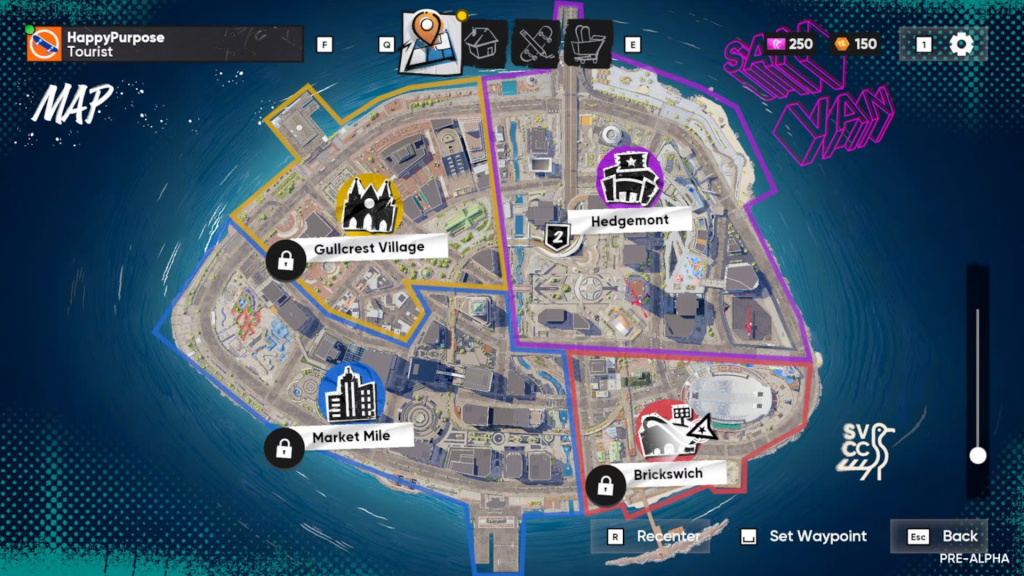
Figure 4: The map of “San VanPark”
Image Source: https://www.pcgamesn.com/skate-4/map
Despite this structure, San VanPark still feels more like a prototype than a lived-in city. Proportions are inconsistent, with benches and ledges often exaggerated to unrealistic scales, breaking immersion. For a series once celebrated for blending skateboarding with urban architecture, it’s a noticeable shortcoming.
One bright spot is the addition of parkour. Being able to climb buildings, vault ledges, and explore vertically adds creativity and a sense of discovery. Rooftop sessions open up new possibilities, and some missions lean into this feature effectively. It’s rough but has real potential to grow into one of Skate’s defining mechanics.
Story, Progression, and Lack of Multiplayer Game Modes
The absence of a traditional story is immediately felt. Instead, progression is tied to levelling up districts by completing challenges, which unlocks missions, loot boxes, and fast-travel points. It’s functional, but it lacks a sense of narrative purpose. Missions are often short and repetitive, and once complete, progression stalls until daily resets. It feels less like a campaign and more like a drip-feed of content.
The writing doesn’t help. Dialogue leans heavily on exaggerated “skater” slang, which feels forced and inauthentic. Even the inclusion of professional skaters, Sean Malto as Shingo, David Gravette as Slappy, and Breanna Geering as Izzy, fails to resonate, as they appear only as fictionalised guides rather than themselves. The result is dialogue that feels both awkward and detached from skate culture.
Game modes are equally sparse. Iconic staples like S.K.A.T.E., Spot Battle, 1-Up, Deathraces, and Own the Lot are absent. What remains is thin: daily challenges, free skate, and Throwdowns, a small-scale score attack mode that feels like filler. The lack of variety is particularly frustrating in a game that is always online, yet often feels oddly lonely.
Hall of Meat, once a fan favourite, feels stripped down in Skate.. The iconic X-ray bone breaks that gave the mode its over-the-top humour are gone, leaving impacts feeling tamer and less entertaining. What remains is still functional as a challenge mode, but it lacks the chaos and slapstick energy that made bailing such a highlight in previous entries.
Challenges
Challenges are at the heart of progression in Skate., and they’re designed to be tackled either solo or in co-op with friends. They provide short, structured goals that break up free skating. Each challenge type has its own flavour, encouraging different playstyles and levels of creativity.
● Own the Spot – A classic returning feature. These challenges focus on making a single iconic trick at a designated spot, whether it’s a handrail, a gap, or a ledge. You’re asked to “shut it down” by leaving your mark on a location, often pushing you to think creatively about how to tackle the terrain.
● Session – These involve skating within a specific zone for a set period of time, chaining together tricks to build up scores or complete objectives. They encourage flow and consistency, rewarding players who can keep combos going while mixing variety into their lines.
● Stunt – Less about skill, more about spectacle. Stunt challenges focus on bails, crashes, and distance, echoing the spirit of Hall of Meat. The aim is usually to throw yourself into awkward spots and see just how far or how hard you can push the physics engine.
● Line – These ask you to follow a sequence of trickable objects, hitting rails, ledges, or gaps in order. They test your ability to stay precise while maintaining rhythm, and they often feel closest to replicating a real street or park line in skateboarding culture.
Together, these challenges form the core structure of what you’ll actually be doing most of the time in Skate. They give a reason to explore San VanPark’s streets and rooftops, even if the variety can start to feel thin after a while. The addition of co-op keeps them fresh for longer, but veterans will likely notice how much lighter this offering feels compared to the richer modes of Skate 3.
Technical Issues
Technical performance leaves much to be desired. In my time with the game I encountered frequent bugs: friends turning invisible during co-op, missions failing to track progress, crashes after completing objectives, and odd camera shifts mid-skate. Party systems also misfire, with hosts only sometimes able to start missions.
Queue times can be frustrating. Sometimes it can take over 15 minutes just to load into the game, and worse, a brief period of inactivity will automatically disconnect you, forcing you to queue all over again. That disruption can kill momentum, especially when you just want to hop on and skate.

Figure 5: Long queue times whilst launching the game
Image Source: https://www.reddit.com/r/Skate4/comments/1nn03ed/online_only_is_great_thank_you_ea/
These issues don’t break the experience entirely, but they do erode trust in its stability. For a live-service title that depends on consistent online play, these problems need urgent attention.
Seasons and Roadmap
EA and Full Circle have made it clear that Skate. will evolve through seasonal updates. Promises include new tricks, skateable areas, branded gear, competitive modes, leaderboards, and expanded customisation. Perhaps most exciting is the addition of community-built parks, which could finally give players the creative freedom to design and share their own iconic spots.

Figure 6: Season 1-3 and beyond Roadmap
Image Source: https://www.reddit.com/r/SkateEA/comments/1n2hgtv/skate_early_access_road_map/
The potential is undeniable, but right now it’s just that: potential. What exists today is a barebones foundation. Whether Skate. grows into a long-term staple or fades as a half-baked experiment will depend entirely on how committed the developers are to supporting it in the months and years ahead.
Accessibility
Accessibility is one of Skate.’s strongest areas so far, with a surprisingly robust set of options aimed at both newcomers and returning players. From control presets to visual and audio settings, the game allows you to tailor the experience to your comfort level. It’s not perfect, but the foundation is impressive.
Pros:
● Ability to toggle traffic on or off
● Numerous HUD removal options
● Choice between classic controls or new streamlined presets
● Adjustable Flick-it stick sensitivity
● Various trick assists, including grind and vert support
● Many auto settings and multiple button swap layouts
● Option to disable certain tricks entirely
● FOV slider and detailed camera settings (vertical and horizontal follow strength)
● Motion blur and depth of field toggles
● Subtitles available
● Streamer mode for music
● Option to disable Vee’s commentary
Cons:
● No Colourblind settings
● No options to change subtitle colour, size, or backdrop
● No ability to switch audio mix between stereo, mono, and surround
Overall, Skate. already offers a commendable range of accessibility tools, giving players real flexibility in how they engage with the game. While a few features are missing, particularly around subtitle and audio customisation, the lack of colourblind options is a significant oversight that could impact usability for some players. Even so, the direction is promising and suggests accessibility will remain a priority as the game evolves.
Conclusion
Skate. is an absolute joy to play. The skating itself is fluid, responsive, and deeply satisfying, with flick-it controls and smooth animations that capture the essence of the series. Parkour, challenges, and co-op add fun layers, making it easy to lose hours exploring San VanPark.
That said, there is still room for improvement: the world feels sparse, key tricks and modes are missing, and technical issues occasionally disrupt gameplay. Despite these shortcomings, the game’s core skating experience is excellent, and with more content and polish in future updates, it has the potential to become a must-play for both veterans and newcomers alike.
Rating: 3.5/5 (with room to grow)
Playtime: 33 hours
Achievements: 19/21

 Kirbylife Game Research & Reviews
Leave a comment