
Spoiler-Free Review:
I picked up Death Stranding: Director’s Cut in anticipation of Death Stranding 2: On the Beach, and after finally playing it properly from start to finish, I can say with confidence, that this is unlike anything else I’ve ever played. Developed by Kojima Productions and published by 505 Games, Death Stranding is the workings of legendary game designer Hideo Kojima, and as I had never played one of his games before, I came into this with an open mind and no expectations.
I had tried the base game a few years ago on Steam, but as someone who isn’t much of a PC gamer, I dropped off around Chapter 5. It didn’t grab me at the time. But I couldn’t stop thinking about it. Something about it lingered. So, with the Director’s Cut now available on Xbox Series X, I decided to give it another go. This time, it clicked in a way I didn’t expect. And when Death Stranding clicks, it really clicks.
Players often dismiss Death Stranding as just a “walking simulator”, but that couldn’t be further from the truth. It’s about planning, problem-solving, community, and resilience. Yes, there’s a lot of walking, but it’s what the walking means that makes it special.
Rebuilding the World, One Delivery at a Time
The game is set in a shattered America after an apocalyptic event called the Death Stranding, which caused the worlds of the living and the dead to collide. You play as Sam Porter Bridges, a lone porter tasked with reconnecting isolated cities and communities through a vast communications network known as the Chiral Network.
It sounds like a simple concept, just deliver cargo from point A to point B. But what makes Death Stranding so engaging is how seriously it commits to that premise. This is not an action-packed shooter or a fast-paced adventure. It’s meditative and deliberate, making you feel every step, every weighty load, every ounce of effort it takes to cross a snowy ridge or muddy valley.
You plan your route, you gear up with ladders and ropes, you balance cargo on your back, and then you go. The challenge comes not from enemies at first, but from nature itself. Slopes, rivers, cliffs, weather. You’re not just traversing a world, you’re learning how to respect it. But when the terrain fights back, with a sudden Timefall rainstorm that begins to corrode your equipment, or when spectral BTs block your path, you realise just how vulnerable you are.
A crucial companion on this journey is Sam’s BB, a Bridge Baby connected to the world of the dead. BB helps detect the invisible, threatening spectral beings called BTs, giving you vital warnings before danger strikes. Beyond its practical role, BB adds an emotional depth, symbolising connection and vulnerability in this fractured world. The bond you form with BB is one of the game’s most memorable and unique features.
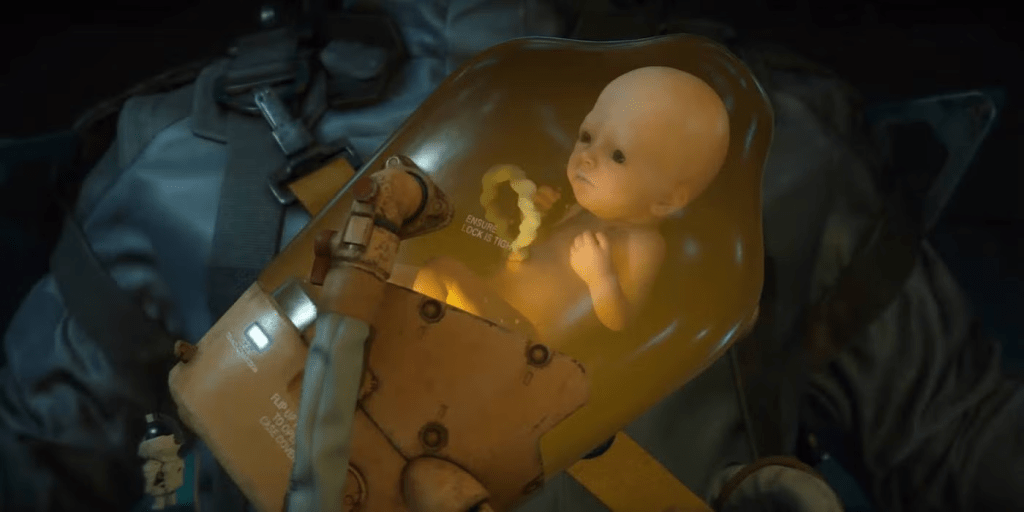
Figure 1: Sam’s Bridge Baby
Image Source: https://gamerant.com/death-stranding-bb-bridge-baby/
Tools, Terrain, and the Tedium That Becomes Tranquil
On paper, Death Stranding shouldn’t work. It’s a game where you spend hours delivering packages. But that’s also what makes it compelling. There’s something strangely satisfying about plotting a path, loading your cargo just right, then executing a perfectly timed delivery.
One of the game’s most vital systems is its weight-balancing mechanic. If you stack cargo poorly or try to sprint without keeping your balance, you will often fall over. The more weight you carry, the harder it becomes to move, especially as you start stacking box after box vertically, making Sam top-heavy and sluggish. You can’t just play one-handed while scrolling through your phone; you’ll trip, wipe out, and have to pick up everything you dropped. It’s frustrating at first, but it teaches you to focus. You’re not just pressing forward, you’re present and immersed.

Figure 2: Delivery Preparation and Cargo Management menu
Image Source: https://www.thegamer.com/death-stranding-distribute-cargo-weight/
Over time the game keeps on evolving.You unlock better equipment, new methods of traversal, and even combat tools. At first, I was always using vehicles to make deliveries easier, but later on I abandoned them entirely because they were becoming too unreliable, getting stuck, running out of power etc. Instead, I built a full zipline network across the mountains. It took a while to set up, but it was so worth it. I was gliding from point to point like some kind of postal Batman.
The Director’s Cut improves this experience drastically. More roads are available early on, new vehicles like the reverse trike, and crucial equipment such as floating carriers now work with ziplines. These changes may seem small, but they massively enhance the pacing and progression, especially during the early and mid-game chapters.
A Story That Unravels Slowly but Hits Hard
If you’ve seen a Kojima game before, you know what to expect, cinematics, lore, and some truly baffling character names. Yes, your protagonist is named Sam Porter Bridges. You’ll meet a woman named Fragile, and a man named Die-Hardman. The names are ridiculous, but they’re part of the charm.
And yet, despite the absurdity, the story is surprisingly profound. It explores themes of connection, loss, isolation, and legacy. Much of the emotional weight comes from the performances. Mads Mikkelsen in particular gives one of the best performances I’ve ever seen in a game. His scenes alone justify sticking with the story.
There’s a real slow-burn mystery to the plot. For the first few chapters, you won’t fully understand what’s going on, but that’s the point. This is a story that’s meant to slowly unfold over 40-50 hours. And when the pieces start falling into place, it makes those earlier moments resonate so much more.
The Soundtrack: A Game That Listens to Itself
Music plays a massive role in Death Stranding. Tracks by Low Roar, Silent Poets, and CHVRCHES punctuate moments of solitude in the best way. After a long, stressful hike, you’ll suddenly crest a ridge, see a city in the distance, and a melancholic track fades in. These are magical moments. The timing is never random. Kojima knew exactly when to drop each song, and it makes the game feel cinematic in the purest sense.
Ludvig Forssell’s ambient score underpins this beautifully, haunting, minimalist, often lonely, but always full of meaning. It’s not just background noise. It’s part of the journey.
Playing Alone, Together
My favourite part of Death Stranding is the asynchronous multiplayer. You never meet other players directly, but their presence is everywhere. Bridges, signs, ropes, ladders, postboxes, they’re all real, built by other people struggling through the same terrain as you.
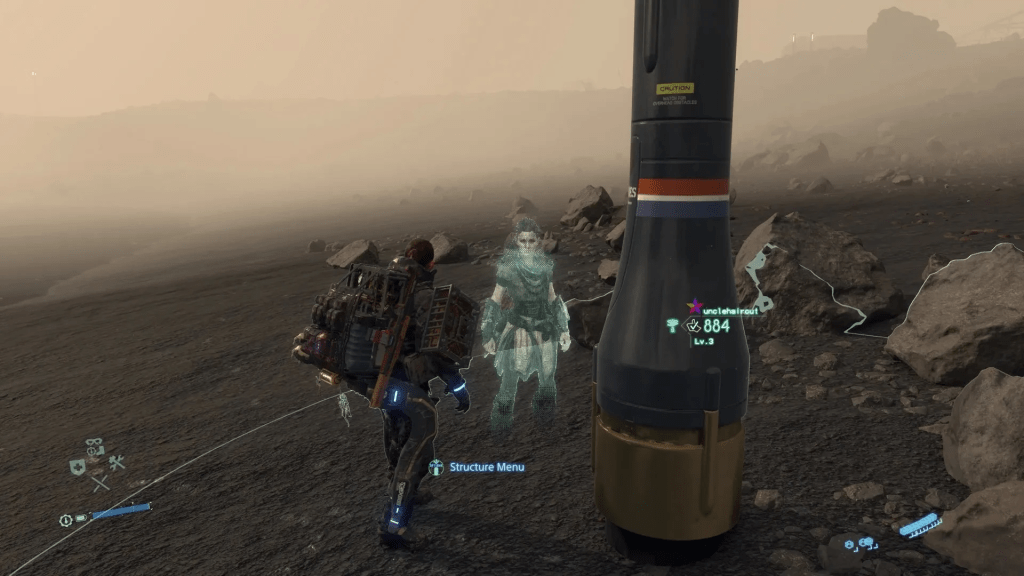
Figure 3: A timefall shelter built by another player, in your world
Image Source: https://deathstranding.fandom.com/wiki/Social_Strand_System
I once scaled a brutal mountainside only to find that after I had connected to a new network, someone had built an entire zipline route that had cut my long journey back right down to a few seconds. That feeling of silent collaboration, of rebuilding the world together, is something no other game has really pulled off. You can also let players know that you appreciated their contribution with the in-game like system which then alerts the player.
It goes deeper than just signs and structures. If you lose or abandon cargo along the way, other players can find and complete those deliveries for you, and you can do the same for theirs. You can also donate unused equipment to shared postboxes, giving players tools or gear they might need. And the biggest contribution of all: you can donate materials to help construct roads, bridges, generators, and more, making tough routes easier for everyone who passes through.
It’s more than a gimmick, it’s the core theme of the game. Connection. Even the smallest action, like leaving a ladder across a river, could save another player ten minutes. That makes every interaction feel meaningful.
When Things Fall Apart: The Frustrations
Despite everything I love about it, Death Stranding isn’t perfect. The combat, for one, isn’t its strong point. enemy encounters can feel unfair when being pulled into tar with little to no warning, or stuck in an endless loop of attacks from boss fights. It can be very frustrating, especially when you lose progress as a result of this, as some boss fights can be very long depending on your difficulty setting.
Saving gets disabled a lot, especially when you enter a BT area or engage in combat. One mission in Chapter 3 locked me out of saving, and I wasn’t actually aware of it, until I died and lost an hour of progress. That’s on me, sure, but it’s also something that could have been signposted better.
Accessibility: Still Stranded
Despite being a re-release, Death Stranding: Director’s Cut still presents significant barriers for many players. While there are a few helpful features, the overall experience remains largely inaccessible to those with physical or visual limitations.
✅ Positives:
● Subtitles have a text size option with “Normal” and “Large” choices. (Though “Large” is more like a standard size.)
● Route plotting via the map lets players draw a path that appears in-game as a guide.
● Suggested routes now show the difficulty level of terrain, offering guidance before traversal.
● Auto-aim is available and helpful during combat.
● Motion control for soothing BB can be toggled off.
❌ Negatives:
● No controller remapping — a basic but vital accessibility feature is missing.
● Constant trigger holds (R2 + L2) are required to maintain balance. Prolonged use is painful or impossible for some players.
● Route plotting requires holding X + dragging the left stick, demanding simultaneous inputs that can be difficult for many.
● Text size does not apply to all in-game UI (such as emails), and many parts of the interface remain too small to read comfortably.
● Subtitles lack background contrast, making them hard to read against varied environments.
● Buddy Bot, Cargo Catapult, and other helpful tools are progression
locked, limiting access early on when they’re most needed.
● Difficulty settings (including Very Easy) only lower combat difficulty, not traversal or balance mechanics.
● Balance sensitivity settings exist but do not reduce the need to hold triggers constantly.
● No colourblind settings were identified.
● No motion sickness or camera shake toggles were identified.
Despite being a game about connection, Death Stranding: Director’s Cut leaves many players disconnected due to its demanding physical input requirements.
A core mechanic (weight balancing), requires players to constantly hold down triggers, which can be physically exhausting or even impossible for those with limited mobility. Multi-button inputs needed for basic traversal add further strain.
Unfortunately, the Director’s Cut makes no meaningful accessibility improvements over the original release, making it a difficult and often unplayable experience for many.
Final Delivery: A Game That Isn’t for Everyone, But Might Be Just for You
Death Stranding: Director’s Cut isn’t for everyone, and it doesn’t try to be. It’s slow, strange, and often demanding, both physically and emotionally. But if you’re willing to embrace its rhythms, it offers something truly different: a meditative experience about connection, persistence, and rebuilding a broken world one step at a time.
It may not stick the landing for every player, but for those it resonates with, it will linger long after the final delivery. A flawed but unforgettable game that dares to do something new, and succeeds more often than it fails. And one thing for sure, is that it is way more than just a “walking simulator”
Achievements: 53/63
Time Played: 47.5 hours
Rating: 4/5

 Kirbylife Game Research & Reviews
Leave a comment