

When it comes to video games, few titles can boast the level of intricacy and immersion that Hollow Knight achieves. It’s not just a game, it’s a meticulously crafted world. At the heart of this masterpiece lies one of its most ingenious features: the map.
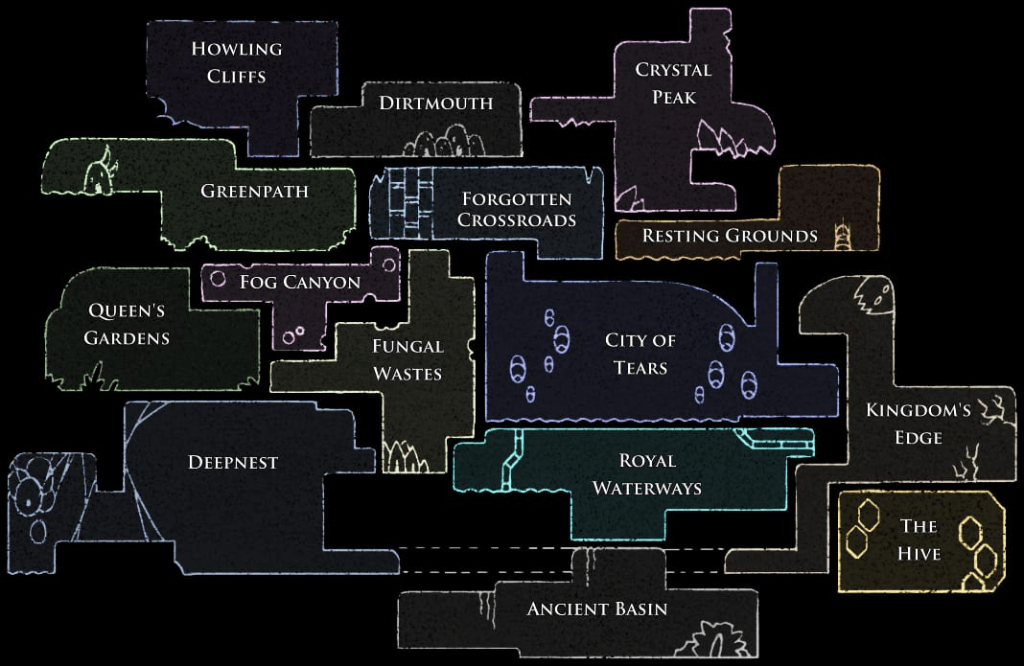
Map of Hallowest Showing Named Locations
You see, in most games, maps are designed to be practical. They’re there to tell you where to go, maybe mark a few points of interest, and that’s it. But in Hollow Knight, the map isn’t just a tool; it’s a character.
Let me set the stage: You’re a tiny, adorable bug with a nail that doubles as a sword, dropped into a massive, crumbling kingdom called Hallownest. The world is interconnected in ways that can make your head spin, and at first, you’re hopelessly lost. Enter Cornifer, a cheerful cartographer humming to himself in the darkness. He sells you incomplete maps of each area, which you can later annotate by sitting on a bench. The catch? He’s not always easy to find, and the act of locating him feels like a mini adventure in itself.
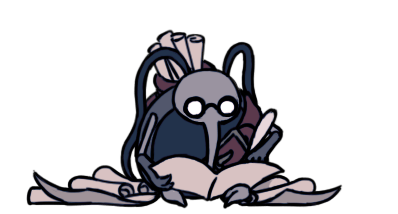
Cornifer : The Map Merchant
And then there’s the moment it all clicks.
A World That Blossoms as You Do
As you explore, collect power-ups, and learn new abilities, Hallownest starts to unfold in layers. That ledge you couldn’t reach before? Now you can wall-jump up it. That chasm that felt impassable? Your newly acquired Crystal Heart sends you soaring across it. The world doesn’t just open up; it invites you back. It dares you to revisit places you thought you understood, only to reveal a hidden passage, a new boss, or even an entirely new area.
The beauty here is that the map evolves alongside your skillset. It doesn’t hold your hand. You’re not constantly bombarded with quest markers and waypoints. Instead, it nudges you to pay attention to your surroundings and use the tools you’ve collected to chart your path forward.
The Joy of Discovery
One of my favorite parts of the game is how it rewards your curiosity, and Cornifer is the enabler of that curiosity. When you buy a map from him, it’s never complete, just a sketchy, partial blueprint of the area, hinting at the paths ahead but leaving plenty for you to discover.
In your adventures, you’ll inevitably find chasms too wide to cross, and doors locked up tight. Which is where Cornifer’s shop partner, Iselda, has your back. She sells a variety of little map markers so you can jot down places you know you’ll want to revisit later. It’s not just exploration; it’s like being your own archaeologist, piecing together the mysteries of Hallownest one marker at a time.

Iselda: Cornifers Shop Partner
But There’s More
Now, while the map system in Hollow Knight stands as my personal favorite feature, the game’s strengths don’t end there. The combat is just as finely crafted, offering a perfect blend of challenge and strategy. The game’s tight, responsive combat mechanics are amplified by the addition of trinkets called Charms, which offer different abilities to help you adapt to various encounters. Whether you want to boost your offensive capabilities, improve your mobility, or give yourself a little more defense, these Charms allow for a personalised combat experience. They encourage experimentation and make every battle feel unique.

Every Charm in Hollow Knight
Each boss encounter feels like a triumph of both combat and discovery. From the terrifyingly intricate Soul Master to the fast-paced Hornet, every boss tests your abilities while also encouraging you to revisit areas you’ve explored, sometimes to gather new Charms or abilities that will give you the edge. The charm system not only expands combat but also works seamlessly with the map system, letting you return to places in Hallownest with newfound power and strategy.
The art style, too, is simply unforgettable. It’s minimalist yet detailed, with each area exuding its own mood and atmosphere. Whether you’re navigating the eerie, dark caves of the Forgotten Crossroads or the hauntingly beautiful City of Tears, the visual storytelling in Hollow Knight makes every corner of Hallownest feel alive and meaningful. The creatures that inhabit this world (both friend and foe) are designed with such care that their personalities shine through even in their static images. Hornet’s fierce elegance, Zote’s self-absorbed bravado, and Quirrel’s humble wisdom are all conveyed in subtle ways through the game’s character designs.
But what really sets Hollow Knight apart isn’t just its world-building, it’s the way the game makes you feel connected to Hallownest itself. The broken beauty of the kingdom, the quiet sorrow of its once-thriving civilisation, and the slow, quiet realisation that the story you’re uncovering is as much about the land as it is about yourself. The emotional weight of exploring this forgotten world, piecing together its past while forging your own journey, is what elevates Hollow Knight beyond just a game. You’re not just fighting to survive, you’re uncovering the soul of Hallownest, and it’s a journey you’ll never forget.
A Legacy of Greatness
It’s no wonder that Hollow Knight has become the gold standard for Metroidvanias. Its map design alone puts most games to shame, and that’s not even touching on the combat, the progression system, or the heartbreaking story. Sure, the upcoming dlc Silksong has impossibly big shoes to fill, but if Hollow Knight taught us anything, it’s that sometimes, getting lost is the best part of the journey. At least we know it’ll be worth the wait… eventually.
So, if you haven’t played it yet, what are you waiting for? There’s a whole kingdom waiting to be discovered, one Cornifer map at a time. Trust me, getting lost in Hallownest is one of the best decisions you’ll ever make. And when you’re done, you’ll know exactly where to go next… eventually.
After 30 hours and 88% completion (so far), I’d rate this experience 5/5 Cornifers. If I could, I’d buy a map to find the words to explain how great this game is.



 Kirbylife Game Research & Reviews
Leave a comment